User Experience Professional
Project Overview
Role: UX Writing + UX Researcher contribution
Client: San Francisco Animal Care & Control
Project type: Web app redesign
Project length: 2 weeks
My contributions: Dog Profile Creation Flow (fields, labels, guidance, tone); Stakeholder Interviews
Tools: Figma, Slack, Google Workspace
PetCode Redesign and UX Writing
San Francisco Animal Care and Control
Pit bulls are often overlooked as pets due to stigma. The associated stigma leads many pit bulls to live the rest of their lives in animal shelters. Additionally, San Francisco Animal Care & Control shelter workers have limited time and struggle to communicate a dog's behavior to potential adopters. Consequently, potential adopters struggle to interpret pit bulls' personalities and needs from dull profiles.
My team designed a web app to show potential adopters the dogs’ personalities through rich multimedia. Furthermore, my team began building a shelter management app so the organization could upload text and multimedia content independently.
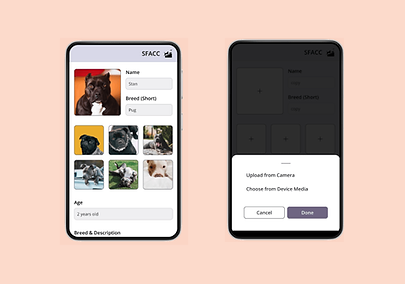
To aid shelter volunteers (often older and with varying levels of tech comfort) in uploading content, I owned the language for the dog profile creation flow. I applied UX writing and research principles to the development of the shelter management app.
Goal: Improve clarity, consistency, and usability when creating dog profiles through the shelter management app.
Result: Unfortunately, the project ended before we could conduct usability testing on the shelter management app.
THE CHALLENGE
My team and I created PetCode as an omnichannel web app enabling San Francisco Animal Care and Control (SFACC) shelter volunteers to share rich, multimedia profiles of dogs with potential pet adopters. However, SFACC relied on us, external volunteers, to upload photos, videos, and text for each dog’s profile.
We designed a shelter management tool that allows shelter volunteers to upload multimedia and text content internally.
As our users were not tech-native, I sought to reduce the risk of:
-
Misinterpreting fields
-
Skipping required inputs
-
Feeling overwhelmed
Volunteers needed to complete structured forms, but unclear language could slow them down or lead to inconsistent data entry.
RESEARCH
Stakeholder Interviews
Due to shelter policy, my research was limited to two (2) interviews with our SFACC liaison. These focused on gathering requirements and understanding volunteer impressions of PetCode’s initial language and instructions.
Crucial Insight
Volunteers preferred plain, familiar language and benefited from specific guidance rather than abstract, “cute,” or system-oriented terms.
DESIGN
UX Writing Contributions
Collaborating with the team’s UX designer, I contributed the following:
-
Labeled buttons to reflect clear actions
-
Wrote instructional text for text fields
-
Helped structure the dropdown/menu language
-
Collaborated with the UX designer to align wording with user needs
Button Clarity
I revised button labels to reduce ambiguity about what happens.
For example, “Save and Exit” became “Save Profile.”
From:

To:

Text Field Instructions
Before:

After:
To help users know what “good input” looks like, I asked questions using plain language.
Before: “What wags this floof’s tail?”
After: “What is the dog’s typical behavior?”

Menu Labels
I edited menu labels to align with user mental models, moving from vague or internal terminology to plain-language categories.
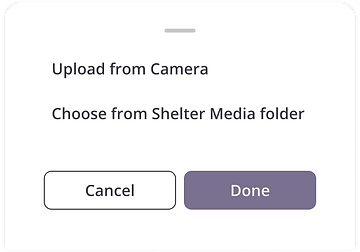
Original menu text

Edited menu text
PROTOTYPE
Design Principles
For this project, I focused on the following:
-
Use plain, familiar language.
-
Reduce ambiguity in actions.
-
Guide users toward complete, useful input.
-
Support users with low technical confidence.
Click through the prototype.

Constraints
For full transparency, I would like to state the project's constraints.
-
Limited research (1 stakeholder interview and 1 follow-up interview)
-
No usability testing before the project’s cancellation
-
Worked within the existing design structure
NEXT STEPS
Maintain momentum
If my team had more resources and access, I would like to perform the following steps to improve PetCode’s usability
-
Test comprehension of labels and iterate on our findings
-
Identify where users hesitate due to language
-
Measure completion rates or errors